497 Search Results Found For : " ŻĶŸ̽ī rkt365.top Time slot ¹ ͳݳ Ÿ ؿ౸ ۽Ʈī ī ũŻ"
India Proposes Retooled Population Policy
(2000) Fifty-three years after independence, India is still looking for a viable policy to control population growth. Although it was the first country to adopt a family planning program, in 1952, the country is still growing by 15.5 million people each year and, if this trend continues, India may overtake China in 2045 by reaching a population of 1.5 billion.
Report. Unintended Pregnancies in the Middle East and North Africa
(2010) Unintended pregnancies are widespread in the Middle East and North Africa (MENA), jeopardizing the health and well-being of women and their families.1 These unplanned pregnancies also exert an unnecessary burden on their countries' health systems and socioeconomic development.
Project: PACE: Policy, Advocacy, and Communication Enhanced for Population and Reproductive Health
Lesson Plan: 2019 World Population Data Sheet
PRB’s World Population Data Sheet is an excellent reference and data analysis tool. Teachers are encouraged to have their students use the Data Sheet for a variety of topics and activities.
Ukraine’s Demographic Reality
(2014) Ukraine, a former republic of the Soviet Union, has undergone a series of dramatic demographic changes since its independence in 1991. Most significant, its birth rate declined sharply following independence, mirroring similar developments in other former Soviet republics.
Moving Beyond ‘Communities’ and ‘Local Actors’ in Development Aid
What real change do these concepts bring to the people directly affected by them?
Progress in U.S. Women’s Well-Being Stalled in Recent Generations
(2017) The level of well-being of young American women (ages 16 to 34) rose significantly for members of the Baby Boom generation but hit a wall for women in subsequent generations, the Population Reference Bureau (PRB) concludes in a new report.
Project: Demography and Economics of Aging and Alzheimer’s Disease
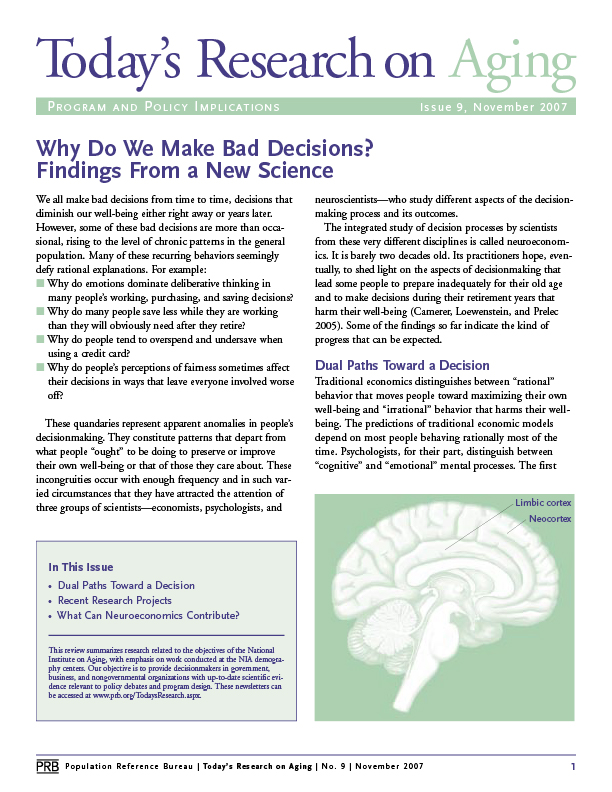
Today’s Research on Aging, Issue 9: Why Do We Make Bad Decisions? Findings From a New Science
(2007) We all make bad decisions from time to time, decisions that diminish our well-being either right away or years later. However, some of these bad decisions are more than occasional, rising to the level of chronic patterns in the general population. Many of these recurring behaviors seemingly defy rational explanations.
Report. Facts of Life-Youth Sexuality and Reproductive Health in the Middle East and North Africa
(2011) One in five people living in the Middle East and North Africa (MENA) region, or nearly 90 million in 2010, is between the ages of 15 and 24, a demographic group called "youth." No longer children, but not yet independent adults, these young people are at a crucial juncture in their lives.